It's traditional at Christmas to play games - so here's one for you. Can you spot the difference between the message of good cheer sent out by BBC News boss Helen Boaden and the gallows humour version sent around by BBC staff?
From: Helen Boaden-PRIVATE
Sent: 21 December 2007 12:03
To: News1; Newsg Bureaux-by-Internet
Subject: Thanks for all your hard work
Dear All,
As some of you prepare to disappear for the Christmas break - and many of you get ready for keeping BBC News on air over the holidays, I want to thank everyone for their work and dedication during a difficult year.
From the kidnap of Alan Johnston to the anxiety over job losses following our reorganisation of News, there haven't been many months when it's felt like "business as usual". Yet despite the challenges to us as an organisation, your focus on doing the best for our audiences has been fantastic. We have done a huge amount of really excellent journalism across all platforms and for all audiences. Whatever your job in BBC News, you should feel proud of being part of that.
2008 is likely to be just as tough in its own way. But we should all take heart from the fact that people in great numbers and across the world continue to trust BBC News and to rely on us to deliver for them.
Thanks again for all your hard work and special thanks to those of you working over Christmas and the New Year.
Warmest good wishes,
Helen.
------------------------------------------------------------------------
Subject: Thanks for all your hard work . THE REAL VERSION
Dear All,
As management prepare to disappear for the Christmas break - and many of you get ready for keeping BBC News on air over the holidays, I want to thank everyone for their work and dedication during a difficult year.
From the kidnap of the BBC News website by advertisers, to the petty grumbles over job losses following our dis organisation of News, it's felt like "business as usual".
Yet despite the challenges to you as a workforce, our focus on doing the best for our own careers has been fantastic.
We have done a huge amount of really imaginative job creation to come up with new senior posts across all platforms.
Whatever your job in BBC News, you should feel proud of being part of that - for however long you've still got it.
2008 is likely to be just as tough in its own way - for you, not me -
But we should all take heart from the fact that people in great numbers have volunteered for redundancy and we will be adding to that with compulsories despite the fact that people across the world continue to trust BBC News and to rely on us to deliver for them.
Thanks again for all your hard work and special thanks to those of you working over Christmas and the New Year - and next year it'll be without UPA .
Warmest good wishes,
Helen.
Ouch! That's gotta hurt..and so it should.
But back to business. Had a meeting this morning with Gerry Morrissey the BECTU General Secretary to catch up on our plans to share more resources, including the possibility of sharing a building and then met with some our Head of Personnel over a number of issues.
I also wrote to Alan Knowles, a member of our Manchester Branch who has served as the NUJ rep on the TUC Pensioners' Committee, for a number of years. He is stepping down and I wrote to say thank you for all his hard work for the union. At the same time a message went from President Michelle Stanistreet and I to all our reps thanking them for all the work they do on behalf of the union. It is never recognised enough.
Friday, December 21, 2007


Thursday, December 20, 2007
Feeling a bit green
Some NUJ staff were feeling a bit green as a result of the previous day (and night's) Christmas lunch. For me, the green feeling was for more worthy reasons! Yesterday I joined other union leaders in pledging our commitment to promote greater environmental sustainability in our unions - both internally and in the workplaces we organise in.
I made the commitment at a TUC-organised breakfast event at which Unison General Secretary Dave Prentis and DEFRA under-secretary of state Joan Ruddock spoke about the key role for unions in promoting collective action on climate change and greening the workplaces.
The NUJ has already taken the first step, promoting better energy efficiency, reducing waste and improving our recycling but we still have a long way to go to significantly reduce our carbon footprint.
Yesterday was part of that commitment to take the next step. You can read more about our future plans here.
Following the breakfast event I attended the TUC General Council at which we discussed public services, new moves to give temporary and agency workers more rights and equality issues in the light of the controversial appointment of Joel Edwards to the Commission on Equality and Human Rights. Rightly the TUC and the NUJ will be protesting about the appointment of someone who has consistently opposed moves to combat discrimination based on sexuality.
The later afternoon was taken up with answering letters, emails and more pensions negotiations with the NUJ Officials' Chapel.
I made the commitment at a TUC-organised breakfast event at which Unison General Secretary Dave Prentis and DEFRA under-secretary of state Joan Ruddock spoke about the key role for unions in promoting collective action on climate change and greening the workplaces.
The NUJ has already taken the first step, promoting better energy efficiency, reducing waste and improving our recycling but we still have a long way to go to significantly reduce our carbon footprint.
Yesterday was part of that commitment to take the next step. You can read more about our future plans here.
Following the breakfast event I attended the TUC General Council at which we discussed public services, new moves to give temporary and agency workers more rights and equality issues in the light of the controversial appointment of Joel Edwards to the Commission on Equality and Human Rights. Rightly the TUC and the NUJ will be protesting about the appointment of someone who has consistently opposed moves to combat discrimination based on sexuality.
The later afternoon was taken up with answering letters, emails and more pensions negotiations with the NUJ Officials' Chapel.
Tuesday, December 18, 2007
New Labour's shame
Monday I attended the TUC Executive Committee which discussed amongst other issues the new Employment Bill which will get its 2nd Reading on January 7th. There are some positive things in it - including tougher enforcement of and penalties for breaching the National Minimum Wage laws. Given our campaign around the abuse of work experience we really welcome the moves.
But this Employment Bill, like others under this Government, is marked out more for what is not in it than what is in it. No one can disagree with measures to enable Tribunals to punish employers more for failing to comply with the ACAS Code of Practice on grievance and disciplinary procedures or measures to reinstate the Polkey principle in unfair dismissal cases but the Bill says nothing about automatic reinstatement in unfair dismissal cases, employment rights from day one, the exclusion of millions from statutory recognition laws or the right to strike. It ignores all the issues raised in the Trade Union Freedom Bill, including simplifying the balloting procedures.
We'll campaign for it to become law but will keep campaigning for the repeal of the anti-union legislation which unfairly shackles unions in effectively representing their members. After all, that was Thatcher's aim when she introduced them. It is to New Labour's shame most of those same laws remain in place.
Rant over. After the TUC Executive it was back to the office to meet with the IT manager and Membership manager to discuss ways to improve the information we hold on the membership database to help with our industrial organising work and then discussions with the pensions actuary to draft a letter to the NUJ Officials' Chapel.
The Independent on Monday carried a small quote from me in a feature on 'unusual' people joining trade unions - it focused on our first member with 'blogger' as their full-time job title. The Guardian's Comment is Free section picked it up and ran a piece from me which was picked up today by Press Gazette.
But this Employment Bill, like others under this Government, is marked out more for what is not in it than what is in it. No one can disagree with measures to enable Tribunals to punish employers more for failing to comply with the ACAS Code of Practice on grievance and disciplinary procedures or measures to reinstate the Polkey principle in unfair dismissal cases but the Bill says nothing about automatic reinstatement in unfair dismissal cases, employment rights from day one, the exclusion of millions from statutory recognition laws or the right to strike. It ignores all the issues raised in the Trade Union Freedom Bill, including simplifying the balloting procedures.
We'll campaign for it to become law but will keep campaigning for the repeal of the anti-union legislation which unfairly shackles unions in effectively representing their members. After all, that was Thatcher's aim when she introduced them. It is to New Labour's shame most of those same laws remain in place.
Rant over. After the TUC Executive it was back to the office to meet with the IT manager and Membership manager to discuss ways to improve the information we hold on the membership database to help with our industrial organising work and then discussions with the pensions actuary to draft a letter to the NUJ Officials' Chapel.
The Independent on Monday carried a small quote from me in a feature on 'unusual' people joining trade unions - it focused on our first member with 'blogger' as their full-time job title. The Guardian's Comment is Free section picked it up and ran a piece from me which was picked up today by Press Gazette.
Thursday, December 13, 2007
No sleep till London..
I'm back (slightly jet-lagged) from Washington and preparing for a full day of meetings after just 30 minutes sleep on the overnight flight.
The Washington conference ended on a note of optimism with some concrete strategies emerging from the hours of discussion. The Global Unions Council meeting in Brussels in mid-January will now have to put flesh on those bones - but there was a genuine realisation we need to be working closer together across borders, pursuing companies wherever their activities may take them instead of limiting ourselves to just domestic campaigning.
One of the shocking facts to emerge at the conference is that collective bargaining coverage in the US is now down to just 12% and that the US is the only country in the world with an entire union-busting industry (even providing support to Chinese companies on how to bust unions) and that someone gets unlawfully sacked every 7 minutes in the US for organising a union. In that context it was good for the 150 or so of us from around the world to be able to join the AFL-CIO on Capitol Hill to lobby representatives. We were joined by Speaker Nancy Pelosi and Senator Ted Kennedy who both spoke enthusiastically in support of the Employee Free Choice Act - a move to provide union rights for workers in the US along similar lines to the recognition legislation in the UK.

Speaker Nancy Pelosi supporting the Employee Free Choice Act on Capitol Hill
Wednesday I met with reps from The Newspaper Guild (the US journalists' union) at the Washington Post. Management from The Guardian had been over there to get ideas from the Washington Post management so it was only right that I heard the union's view about developments at the titles. The issues are very similar to those faced by journalists at papers here. We agreed some concrete actions including greater sharing of information on terms and conditions.

With Washington Post union reps
I also met with one of the NUJ members working for The Guardian in their Washington bureau and with Debby Zabarenko, the Guild's rep at Reuters. We discussed the Reuters/Thomsons merger and the failure of the company to provide concrete information on the future shape of the operation and planned some joint activity for early in the new year.
Now I'm back and heading for a meeting with Thompsons, the union's solicitors.
The Washington conference ended on a note of optimism with some concrete strategies emerging from the hours of discussion. The Global Unions Council meeting in Brussels in mid-January will now have to put flesh on those bones - but there was a genuine realisation we need to be working closer together across borders, pursuing companies wherever their activities may take them instead of limiting ourselves to just domestic campaigning.
One of the shocking facts to emerge at the conference is that collective bargaining coverage in the US is now down to just 12% and that the US is the only country in the world with an entire union-busting industry (even providing support to Chinese companies on how to bust unions) and that someone gets unlawfully sacked every 7 minutes in the US for organising a union. In that context it was good for the 150 or so of us from around the world to be able to join the AFL-CIO on Capitol Hill to lobby representatives. We were joined by Speaker Nancy Pelosi and Senator Ted Kennedy who both spoke enthusiastically in support of the Employee Free Choice Act - a move to provide union rights for workers in the US along similar lines to the recognition legislation in the UK.

Speaker Nancy Pelosi supporting the Employee Free Choice Act on Capitol Hill
Wednesday I met with reps from The Newspaper Guild (the US journalists' union) at the Washington Post. Management from The Guardian had been over there to get ideas from the Washington Post management so it was only right that I heard the union's view about developments at the titles. The issues are very similar to those faced by journalists at papers here. We agreed some concrete actions including greater sharing of information on terms and conditions.

With Washington Post union reps
I also met with one of the NUJ members working for The Guardian in their Washington bureau and with Debby Zabarenko, the Guild's rep at Reuters. We discussed the Reuters/Thomsons merger and the failure of the company to provide concrete information on the future shape of the operation and planned some joint activity for early in the new year.
Now I'm back and heading for a meeting with Thompsons, the union's solicitors.
Tuesday, December 11, 2007
Mr Dear Goes to Washington
I'm still here in Washington at the Global Unions Council Organising, Recognition and Union Rights Conference.
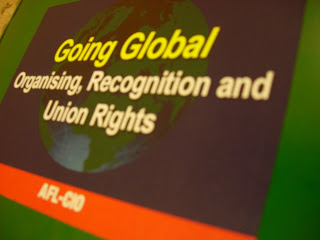
For a while there it didn't look promising as we were treated to a succession of long speeches liberally peppered with quotes from those giants of the labour movement - Oscar Wilde and George Meaney - warning against taking up conference's time with long speeches. When someone quoted Mother Teresa I almost lost the will to live.
But things picked up - and it's just as well. Here's some facts we have to contend with:
* Employment is growing worldwide yet there is less 'decent' work
* Workers have a positive view of trade unions yet union density is falling (in the UK it is just 28%).
* Collective bargaining coverage is decreasing - in the UK it is now just 35%.
* As bargaining coverage declines so inequality grows.
The question for us all here is how do we go about changing this.
Well the conference itself is a start - it is historic. It is the first time ever all the representatives of the global trade union movement have come together. Hey, we've even got both parts of the US labour movement here - the AFL-CIO and the Change to Win coalition.
Today we set about trying to come up with practical ways to organise globally. Capital is global, unions must be too. In practical terms that means how do we share resources, devise strategies for building unions, learn from each others experience of good and bad organising initiatives, look at the role of research and communications in building unions, at the political obstacles and opportunities, consider the pros and cons of international framework agreements and so on. A lot of good ideas came up.
Tomorrow we will try and pull together a plan of action which the Global Unions Council - at which I will represent the International Federation of Journalists - will be charged with putting in to practice over the next couple of years.
As usual a lot of the best discussions happen around the fringe - and the media and journalists unions from the US, Australia, Canada and UK have really used that time to share experiences on a range of topics.
As well as the conference I have today sorted out a quote for the Press Gazette end of year round up, and wrote a model letter as part of our campaign to get MPs to target those who abuse work experience and drafted a quote for use tomorrow on Conrad Black being sent down. It couldn't happen to a nicer crook!

For a while there it didn't look promising as we were treated to a succession of long speeches liberally peppered with quotes from those giants of the labour movement - Oscar Wilde and George Meaney - warning against taking up conference's time with long speeches. When someone quoted Mother Teresa I almost lost the will to live.
But things picked up - and it's just as well. Here's some facts we have to contend with:
* Employment is growing worldwide yet there is less 'decent' work
* Workers have a positive view of trade unions yet union density is falling (in the UK it is just 28%).
* Collective bargaining coverage is decreasing - in the UK it is now just 35%.
* As bargaining coverage declines so inequality grows.
The question for us all here is how do we go about changing this.
Well the conference itself is a start - it is historic. It is the first time ever all the representatives of the global trade union movement have come together. Hey, we've even got both parts of the US labour movement here - the AFL-CIO and the Change to Win coalition.
Today we set about trying to come up with practical ways to organise globally. Capital is global, unions must be too. In practical terms that means how do we share resources, devise strategies for building unions, learn from each others experience of good and bad organising initiatives, look at the role of research and communications in building unions, at the political obstacles and opportunities, consider the pros and cons of international framework agreements and so on. A lot of good ideas came up.
Tomorrow we will try and pull together a plan of action which the Global Unions Council - at which I will represent the International Federation of Journalists - will be charged with putting in to practice over the next couple of years.
As usual a lot of the best discussions happen around the fringe - and the media and journalists unions from the US, Australia, Canada and UK have really used that time to share experiences on a range of topics.
As well as the conference I have today sorted out a quote for the Press Gazette end of year round up, and wrote a model letter as part of our campaign to get MPs to target those who abuse work experience and drafted a quote for use tomorrow on Conrad Black being sent down. It couldn't happen to a nicer crook!
Monday, December 10, 2007
Howdy!
Howdy - as they say round these parts. I'm in Washington (that's US of A not County Durham) to represent the International Federation of Journalists at the grandly titled Global Unions' Council.
Tonight at the National Labor College I met up with the leaders of the journalists' unions from the US, Canada and Australia who are all also here as IFJ delegates as well as IFJ General Secretary Aidan White and we've been able to have a useful discussion about how best to work together in the face of increasingly global companies - such as Newsquest, Reuters and News International.
It was particularly interesting to hear about The Newspaper Guild's Save Journalism campaign which mirrors our own Stand Up for Journalism activity.
But back to the conference. Normally I avoid these kind of events like the plague but I hold out some more hope for this one coming up with some concrete activity.
All around the world trade unionism is facing severe challenges and we need to act to defend and promote the right to organise, develop the legal and political framework for union organising and address issues such as international organising - capital is global but trade unionism is still far too rooted within national boundaries. There are some fascinating experiments going on with global trade union organising (including the global framework agreements in journalism) and I'm hoping we can turn some of those in to practical activity which will help us build bigger, stronger, more effective unions for journalists and all other workers.
That's the hope - in 48 hours I'll know if any of that has been achieved or whether the 185 delegates representing the entire world trade union movement have simply allowed the opportunity to pass by in favour of another talking shop.
Tonight at the National Labor College I met up with the leaders of the journalists' unions from the US, Canada and Australia who are all also here as IFJ delegates as well as IFJ General Secretary Aidan White and we've been able to have a useful discussion about how best to work together in the face of increasingly global companies - such as Newsquest, Reuters and News International.
It was particularly interesting to hear about The Newspaper Guild's Save Journalism campaign which mirrors our own Stand Up for Journalism activity.
But back to the conference. Normally I avoid these kind of events like the plague but I hold out some more hope for this one coming up with some concrete activity.
All around the world trade unionism is facing severe challenges and we need to act to defend and promote the right to organise, develop the legal and political framework for union organising and address issues such as international organising - capital is global but trade unionism is still far too rooted within national boundaries. There are some fascinating experiments going on with global trade union organising (including the global framework agreements in journalism) and I'm hoping we can turn some of those in to practical activity which will help us build bigger, stronger, more effective unions for journalists and all other workers.
That's the hope - in 48 hours I'll know if any of that has been achieved or whether the 185 delegates representing the entire world trade union movement have simply allowed the opportunity to pass by in favour of another talking shop.
Friday, December 07, 2007
It's not big and it's not clever...
Jonathon Ross, desperate as ever for attention, slagged off his BBC colleagues at a TV Awards show. Naturally we commented on it! It's probably not as forceful a comment as I would like to have made but at least it could be printed in a family newspaper. It's certainly not as 'obscene' as the comments BBC members have been sending in to us about Mr Ross's flaunting of his excessive salary.
Started to get feedback from the report of the multimedia commission (generally good)and the launch of the new website (very positive). Even the few technical glitches seem to have been ironed out.
Yesterday was my birthday (41 in case you were wondering) and I had the day off to head to Brussels to see Spurs play Anderlecht in the UEFA Cup last night. A fantastic night even if the game was pretty poor.

Now it's back to getting through the 198 emails which arrived yesterday and the backlog of post. Oh, and I've 150 Christmas cards to sign. Bah Humbug!
Started to get feedback from the report of the multimedia commission (generally good)and the launch of the new website (very positive). Even the few technical glitches seem to have been ironed out.
Yesterday was my birthday (41 in case you were wondering) and I had the day off to head to Brussels to see Spurs play Anderlecht in the UEFA Cup last night. A fantastic night even if the game was pretty poor.

Now it's back to getting through the 198 emails which arrived yesterday and the backlog of post. Oh, and I've 150 Christmas cards to sign. Bah Humbug!
Thursday, December 06, 2007
A night on the town with Gordon Brown....
Today the NUJ launched its new website – like all such changes it’s a work in progress but it’s already a huge improvement on the old site – more resources, fresher design, more interactivity, a better search engine and with many more new functions to come over the next few months. And it’s the home to this blog!
So if you’ve come to my blog for the first time through the site today – welcome. If you’ve been here before you may wish to scroll down and find out what Gordon Brown and I got up to last night while I explain to newcomers the purpose of the blog.
When I launched the blog in September 2007 I wrote its purpose was
I don't find time to write every day - but I hope the blog will give you a flavour of what your union does and how it is fighting day in day out for journalists and journalism.
So welcome. Now you too can find out what Gordon and I got up to last night.
I spent last night on the town with Gordon Brown. Ok, It was only at an event to mark the 70th anniversary of Tribune but it’s as close as trade union leaders seem to get to the Government these days.
Gordon has been off in recent days praising the local media for their role in “building communities” at the same time his Ministers have been busy saying no, no and thrice no to any discussion over the impact job cuts and lack of investment are having on the ability of the media to keep providing quality coverage of local issues. Apparently ITV’s axing of local news services and local newspapers axing of hundreds of jobs are apparently not worthy of investigation or even a line in Gordon’s speech. But of course given the Government’s current troubles it’s hardly surprising they won’t stand up for quality journalism – who knows what journalists with the time and resources might uncover.
Prior to that I had meetings with the NUJ Officials’ Chapel about planned changes to the staff pension scheme, filmed an interview for the BBC Glasgow campaign website against the BBC job cuts, met with Bectu to discuss our plans for sharing more resources including the possibility of sharing a single building and gave final sign off to the new web pages and the report of the Commission on Multimedia Working.
The report, Shaping the Future, is the result of several months work and evidence gathering about new media working across the industry. It is a damning indictment of those who try to do integration on the cheap but a ringing endorsement of well-resourced new media operations. It is packed full of practical recommendations.
I wrote an article for the media guardian website and the launch of the report is being covered by Press Gazette and media guardian.
So if you’ve come to my blog for the first time through the site today – welcome. If you’ve been here before you may wish to scroll down and find out what Gordon Brown and I got up to last night while I explain to newcomers the purpose of the blog.
When I launched the blog in September 2007 I wrote its purpose was
“about not only giving members an insight in to the work their union carries out on a day to day basis far away from the headlines, work which improves the lives of journalists every day but also hopefully helping to increase the accountability of myself as the elected General Secretary and the union as a whole to its members".
I don't find time to write every day - but I hope the blog will give you a flavour of what your union does and how it is fighting day in day out for journalists and journalism.
So welcome. Now you too can find out what Gordon and I got up to last night.
I spent last night on the town with Gordon Brown. Ok, It was only at an event to mark the 70th anniversary of Tribune but it’s as close as trade union leaders seem to get to the Government these days.
Gordon has been off in recent days praising the local media for their role in “building communities” at the same time his Ministers have been busy saying no, no and thrice no to any discussion over the impact job cuts and lack of investment are having on the ability of the media to keep providing quality coverage of local issues. Apparently ITV’s axing of local news services and local newspapers axing of hundreds of jobs are apparently not worthy of investigation or even a line in Gordon’s speech. But of course given the Government’s current troubles it’s hardly surprising they won’t stand up for quality journalism – who knows what journalists with the time and resources might uncover.
Prior to that I had meetings with the NUJ Officials’ Chapel about planned changes to the staff pension scheme, filmed an interview for the BBC Glasgow campaign website against the BBC job cuts, met with Bectu to discuss our plans for sharing more resources including the possibility of sharing a single building and gave final sign off to the new web pages and the report of the Commission on Multimedia Working.
The report, Shaping the Future, is the result of several months work and evidence gathering about new media working across the industry. It is a damning indictment of those who try to do integration on the cheap but a ringing endorsement of well-resourced new media operations. It is packed full of practical recommendations.
I wrote an article for the media guardian website and the launch of the report is being covered by Press Gazette and media guardian.
Tuesday, December 04, 2007
Facing up to life in prison
Monday morning and in early to write the foreword to the final report of the NUJ's Commission on Multimedia Working which will be published later this week.
Then it's on with President Michelle Stanistreet to a meeting with Keith Mallinson, the UCU Executive member responsible for prisons, to discuss issues of concern about the NUJ Pathways to Journalism scheme which is run in conjunction with various prison magazines, the Writers in Prison Network and supported by the National Council for the Training of Journalists. It was a project I helped launch soon after I started working at the NUJ in 1998 - and is now a nationally recognised part of prison education, giving those who work on prison magazines a structured training scheme at various levels to help them learn more about journalism and the skills involved in being a journalist. Of course, it is difficult in high security prisons like Wandsworth to recreate a newsroom but the course helps many achieve increased skills and real self-confidence at seeing their work improve and get published.
Next up is a meeting with Roy Mincoff, the union's legal officer, to discuss the NUJ's legal services. Our current contract runs out early next year and we need to plan how best to provide the services members need after that. We look through performance records, case types and expenditure and will put a paper together for the Finance Committee on 11 January setting out a new tender process.
The rest of the day is spent dealing in meetings and phone calls with individual cases - and signing off pages for the redesigned website which will go live later this week.
Then its home, armed with the final version of the multimedia commission report - and two hours of reading through for any last minute changes. Tomorrow it goes to be designed for its launch on Thursday.
Then it's on with President Michelle Stanistreet to a meeting with Keith Mallinson, the UCU Executive member responsible for prisons, to discuss issues of concern about the NUJ Pathways to Journalism scheme which is run in conjunction with various prison magazines, the Writers in Prison Network and supported by the National Council for the Training of Journalists. It was a project I helped launch soon after I started working at the NUJ in 1998 - and is now a nationally recognised part of prison education, giving those who work on prison magazines a structured training scheme at various levels to help them learn more about journalism and the skills involved in being a journalist. Of course, it is difficult in high security prisons like Wandsworth to recreate a newsroom but the course helps many achieve increased skills and real self-confidence at seeing their work improve and get published.
Next up is a meeting with Roy Mincoff, the union's legal officer, to discuss the NUJ's legal services. Our current contract runs out early next year and we need to plan how best to provide the services members need after that. We look through performance records, case types and expenditure and will put a paper together for the Finance Committee on 11 January setting out a new tender process.
The rest of the day is spent dealing in meetings and phone calls with individual cases - and signing off pages for the redesigned website which will go live later this week.
Then its home, armed with the final version of the multimedia commission report - and two hours of reading through for any last minute changes. Tomorrow it goes to be designed for its launch on Thursday.
Subscribe to:
Posts (Atom)